
More than once I have been asked about what is needed to be a Project Manager. The people I talked to were really interested in become a Project Manager (PM) due to they want a new job, they want to improve at their performance at her/his current role or they were thinking about their future & career path. After the third discussion, I realize they might use to think (prior to our conversation) about this Project Management profession as something mysterious, kind of difficult &/or hard to achieve; perhaps like if they had just decided they want to become a Jedi and they need to start with the Padawan training, or like a new Hogwarts student thinking about get their first magical wand.
So, I have these questions to answer? Who is and what does a Project Manager? What is the Project Manager Path? How can someone become a PM? Do they have superpowers as well? What they we have in common? Is really that difficult? Where could someone start this career?

Not everyone can become a great artist, but a great artist can come from anywhere. It is difficult to imagine more humble origins than those of the genius now cooking at Gusteau’s, who is, in this critic’s opinion, nothing less than the finest chef in France. (Ratatouille movie)
Yes indeed, just like that wonderful movie says, anybody can become a Project Manager (we already do in some way amateur PM) but if you really want/desire to succeed as a PM it is required to prepare, study & practice more until your master this fabulous art of improve people’s life by guide them through uncertainty.
Technically speaking, a Project Manager is «…the person assigned by the performing organization to lead the team that is responsible for achieving the project objectives …» (PMBOK 6th Ed; 3 The Role of the Project Manager); in order to achieve this, she/he must develop and improve three relevant competences that will provide her/him with the skills needed:
- Technical project management, the knowledge, skills, and behaviors related to specific domains of a project, program, and portfolio management.
- Leadership, the knowledge, skills, and behaviors needed to guide, motivate, and direct a team, to help an organization achieve its business goals.
- Strategic and business management, the knowledge of and expertise in the industry and organization that enhanced performance and better delivers business outcomes.
Also, and per the PMBOK 6th Ed; 3 The Role of the Project Manager, a very relevant activity of a Project Manager activities is to communicate, that could include:
- Developing finely tuned skills using multiple methods (e.g., verbal, written, and nonverbal)
- Creating, maintaining, and adhering to communications plans and schedules
- Communicating predictably and consistently
- Seeking to understand the project stakeholders’ communication needs
- Making communications concise, clear, complete, simple, relevant, and tailored
- Including important positive and negative news
- Incorporating feedback channels
- Relationship skills involving the development of extensive networks of people throughout the project manager’s spheres of influence.
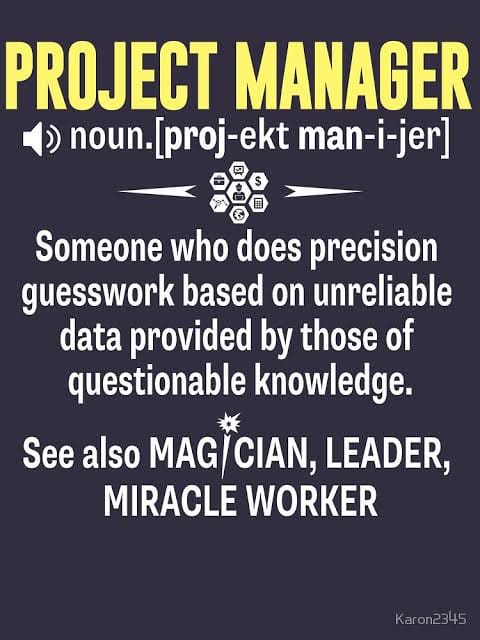
Just like projects are unique, the specific role of a Project Manager might vary from one company to another, it all depends on the Organizational Project Management (OPM); however, these competences are important and relevant regardless the industry or sector.
*Funny fact: from time to time we find definitions of a PM role like this (image on the right); it is really asome and cute, but very in some way because, as Project Managers, we work with assumptions (unreliable data) to develop project documents and schedules (precision guesswork) that help people to create something unique (those of questionable knowledge).
So, if you want to start or keep improving your performance as a Project Manager, keep/start developing your Technical skills (skills to effectively apply project management knowledge
to deliver the desired outcomes for programs or projects), your Strategic and Business Management Skills (the ability to see the high-level overview of the organization and
effectively negotiate and implement decisions and actions that support strategic alignment and innovation), your Leadership skills (the ability to guide, motivate, and direct a team) and also I recommend you to develop and reinforce your Interpersonal skills, that you will need (just like your toolbox) as PM for sure:
- Leadership
- Team building
- Motivation
- Comunication
- Influencing
- Decision making
- Political and cultural awareness
- Negotiation
- Facilite to others
- Manage conflict
- Coaching
Complete courses, read books, teach others, I mean keep preparing and training yourself. There is no one and unique path to become a Project Manager; it is OK to have a different rhythm to achieve it, but regardless the project or your development timing you will use all these skills, at higher or lower rate, in the endeavors you lead or participate in.
I wish for you all the best and the major of the success, my marvelous magicians / leaders / miracle workers (aka. Project Managers)
 Cambalache Projects
Very nice article, totally what I wanted to find.
Me gustaMe gusta
I am in fact pleased to read this webpage posts which carries lots of helpful facts, thanks for providing these kinds of
statistics.
Me gustaMe gusta